Your Fearless Travelers

Your Fearless Travelers

Wednesday, February 1, 2012

Paradise Found- Fiji


When God expelled Adam and Eve from the Garden of Eden in the book of Genesis it seemed that paradise, at least here on earth, would be eternally lost to mankind. Like vegans at a rib joint, those first humans found their eating habits at odds with their host (God didn't want them to know that fruit from the tree of the knowledge of good and evil is actually delicious with strawberries and cream). A bit of a row ensued and they found themselves unceremoniously dumped outside the garden walls, forced to till the earth for food through strenuous labor. God even left a bouncer in the form of a cherubim with a flaming sword on the eastern edge of the garden to keep those naked apes from rushing back in and setting up shop to wait for judgement day. But, as anyone who's ever been turned away by the doorman at a hip Manhattan club should know, there is always another way in.
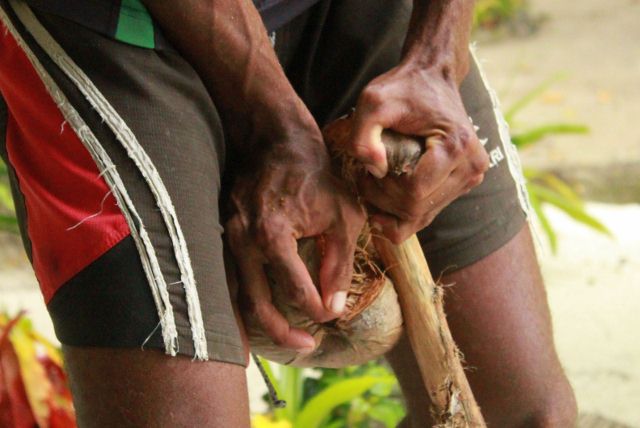
A Fijian demonstration of how to get into those pesky brown coconuts
The backdoor to paradise turns out to be the warm waters of the South Pacific. When Dutch explorer Abel Tasman first sailed into Fijian waters in 1643 he must have checked his pulse to make sure he hadn't died and gone to heaven. He saw emerald green islands bursting with lush tropical forests rising up from sapphire waves like enormous sea turtles basking in the golden equatorial sun. Brown skinned natives, unencumbered by clothes, dove for fish in the crystal clear sea or plucked sweet fruits from the trees.

With these abundant resources, it's nearly impossible to go hungry in Fiji. And like their biblical forebearers, the inhabitants of these verdant, oceanic island jewels also had some rather peculiar eating habits. But the Fijian's tastes were slightly more visceral in nature; think canibalism. That, along with the fierce warrior traditions of the Fijian people, kept European sailors and settlers at bay for the next hundred years or so.
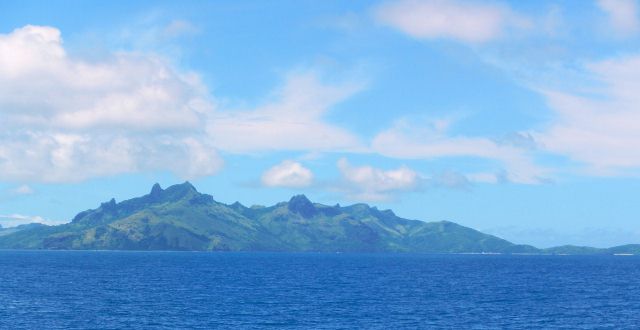

Molly and I arrived in this other Eden under the cover of darkness after a long and much delayed flight from Los Angeles. Our flight landed in the city of Nadi on the large island of Viti Levu. The next day at dawn we boarded a large, yellow catamaran bound for the Yasawa islands, a sparsly inhabited archipelago northwest of the main island.


Along the way we passed dozens of islands, some as small as thirty yards across, most of which had small resorts on them. 


At one point I looked around and counted 35 distinct islands in sight and countless other looming blues shapes in the distance that might have been islands or perhaps just large clouds, it was hard to tell. After a few hours of sailing, the catamaran was met by a small motorboat that took us to our hut on the tiny island of Matacawalevu, just a few minutes from where a topless Brooke Sheilds frolicked in the waters of The Blue Lagoon and a bearded Tom Hanks made friends with a volleyball when he was a Castaway.

The Yasawa Flyer catamaran in the distance

A typical Fijian Bure
Our hut was everything you would expect from a remote tropical paradise. It was situated right on the beach shaded by coconut, mango and papaya trees. Out front, a hammock swaying gently in the island breeze practically begged to be cast in a Corona commercial. Although it lacked certain modern conveniences like electricity and hot water it was about as close to perfection as you can get.  

A tiny visitor in our hut


That afternoon we went snorkeling. We had to wait until high tide because at low tide, the water in the strait between our island and the next island was very shallow and VERY warm, probably around 85 or 90 degrees. High tide brought deeper waters and cooler temperatures (around 75 degrees). We decided to take our brand new waterproof/shockproof digital camera to get some pictures of the local sea life. We bought it specifically because it was supposed to be rough and ready for scuba diving and underwater fun.  


We swam around and took pictures for about 45 minutes and then IT BROKE. This was the first time we used it. We didn't drop it or do anything wrong. It just stopped working. We worked it out and for the price, the camera cost about $8 per minute. Thanks a lot Nikon!  

All bitching aside, we did get to see some amazing  sea life--- from bright orange clown fish swimming in their anemone homes to a giant royal blue starfish hiding under delicate branches of coral.


The next day we took a sea kayak across the strait to the island of Yaqeta. As we were crossing, a giant sea turtle surfaced right in front of our boat. Its shell must have been three feet in diameter. It looked at us for a moment with its huge black eyes before disappearing beneath the waves.

On Yaqeta we sunbathed, collected shells and waded through tide pools.


At one point an island native came strolling out of the jungle holding a 3 foot machete. It was startling at first but he greeted us with a broad smile and friendly "Bula!" (Hello). From behind him, his four children burst through the trees and ran headlong into the water, laughing and splashing. 

Small boy/Biiiig knife
It should come as no surprise that Fijians are some of the happiest people on earth and are very interested in talking to visitors although they are very isolated from the outside world. And although they are isolated, they still seemed to know a bit about the US. 
Him: Where are you from?
Me: New York City.
Him: Is that close to Los Angeles?
Me: Not exactly.

The next few days were spent lounging, swimming and kayaking all over the island which makes for great vacationing but rather boring blogs. (How many times do you need to hear me say "And then I poured some rum in a coconut and took a nap in the hammock"?)

Who wants an OYSTAH?

On our final day we hopped into a boat with some of the locals and went to church on the other side of the island.
The boat ride to church
 On an island with a population of about 200 people, about 150 of them were in church. Everyone was decked out in their finest Fijian garb (it was exactly like a Hawaiian garb, but in Fiji) so that the congregation looked like a rainbow of flowers had exploded all over the inside of the building. There was at least one child for every adult at the service and since everyone was related to eachother, the children would simply wander around smiling and jumping into people's laps for a little while before getting up in search of a more comfortable lap. 

The most beautiful part by far however was the singing. The songs were all multi-part harmonies with the angelic sopranos of the women rising delicately above the booming bass of the men. No one had hymnals or books so all of the songs were sung from memory. It was a truly wonderful.

One thing that struck me while in Fiji, aside from the extreme beauty, was how seriously they take the problem of global warming. Everywhere you look there are signs; "Don't waste water, reduce our carbon foot print" and "Turn off the lights, help eliminate greenhouse gases".  There are no idiot reporters from Fox News trying to confuse the issue by saying there is not enough evidence or that our economy cannot withstand a change to a more ecologically sustainable model. This is the front line of climate change. As the mercury shoots up, rising ocean temperatures will spawn more and more destructive tropical storms. Fortunately for us, our trip to Fiji had beautiful wather, but unfortunately for the Fijians that week was bookended by two cyclones that battered the islands and left many areas damaged and flooded. Furthermore, most of these precious islands are only a few feet above sea level. As the global ice caps melt and sea levels rise, more and more of these places will be swallowed up by the ravenous Pacific Ocean. We have reached a tipping point in history where decisive action can cause positive changes. Unfortunately, if we do nothing, this place will slip slowly beneath the waves and paradise will once again be lost.


Tuesday, January 24, 2012

South American Epilogue- The Christmas Miracle

As we headed back to the USA from South America, we had our hands full with everything we had been carrying for the past four months, as well as the huge bag of presents that we brought home to give to our families as Christmas gifts. The bag we got to carry the presents was typical of South America. It was a bright, multicolored woven plastic bag with a bunch of Spanish words and a picture of the Lion King on it. Turns out, what is typical in South America doesn't even exist in North America. Because of it's important contents, and it's ridiculously bright exterior, we kept a close eye on that bag of gifts. After travelling with the bag for almost 3000 miles (Quito to Panama City to Orlando to New York to Boston), it had become an extension of myself. Until we put it down on the curb outside South Station, to load our other bags into the car.... and left it there.

We didn't realize that we had left the bag until almost 11 o'clock that night, at which point it was too late to go back into Boston to look for it. Bill Waterhouse, always a man with ideas, suggested that we head back into Boston the following morning to check the lost and found at South Station. After all, it was Christmas time. People have a tendency to be kind at that time of year.

When I arrived at South Station, I realized that each of the different sectors of the station have their own lost and found. So over the next half an hour, I checked in with the lost and found at the bus terminal, the commuter rail and at Amtrak, but to no avail. I was feeling quite demoralized as I walked by the entrance to the Red Line subway. I figured it was a long shot, but I might as well check to see if they had a lost and found.

As I got to the bottom of the stairs, I saw an area with transit workers and asked one of them if there was a lost and found. He told me I would have to go to another train station to check the lost and found there, which, at that point, I did not want to do. I was ready to head home in utter defeat, but then something caught my eye. 

In a wire basket in front of the transit office was a bright, multicolored bag. Having just spent four months in South America where EVERYONE has that exact bag, I immediately thought, "Huh. I guess someone else has the same bag." I walked over to the basket and asked the transit worker about the bag. He practically screamed at me, "What do you know about this bag???" 

I told him that I thought this was the bag I was looking for, and as I reached in to pull the bag out of the basket I saw the tell-tale Lion King on the back side of the bag. As the realization dawned on me that this was my bag, another transit worker came out of the office and started yelling. He demanded to know what I knew about the bag, how I knew it was here and what I had to do with all of this. I explained to him that I accidentally left the bag on the sidewalk last night, but that I'd like to take it home. Not so fast, he told me.

He opened his cell phone and showed me a picture of a make-shift table and proceeded to tell me the story of my missing bag. At some point the previous night, someone took the bag from the street and brought it down into the subway. They removed all of the contents and set up a display on the subway platform. He displayed the table runners that Mark and I bought for our moms, the silver and mahogany tray, the blanket I bought for my sister-in-law, a bowl for my dad and a few other things... and he tried to SELL THEM! 
Fortunately for me, this person tried to be slick and set up the table just outside the line of sight of the security camera. Somehow, the transit authority had been alerted and found this man's activity to be extremely sketchy. So sketchy, in fact, that they called the bomb squad in to investigate. The bomb squad had finished about 10 minutes before I arrived in the station. 

As he was telling me all this, I was looking through the basket and realized that every single gift was still there. Not one gift was missing. As he finished telling me the story of my bag, I burst into tears and started screaming at the top of my lungs, "IT'S A CHRISTMAS MIRACLE!!" In that wonderful, gruff Boston way, the two transit workers kept saying, "Lady. Calm down, lady. Lady. Stop crying, lady!" I got the sense that they were going to detain me and try to find out more from me about this bag, which had caused so much trouble, but they couldn't calm me down from crying and screaming about the Christmas miracle. I think they were just happy to get me out of there. 

As I collected my things and put them all into the bag to take home, I looked up at the transit worker. "Who would do something like that?" I asked. "Oh, you know these subterranean people." I guess I do now.

So, THANK YOU subterranean people (or Mole People, if you prefer) for stealing my stuff, trying to sell it, and getting the bomb squad to make sure it was all good so they could return it to me, just in time for Christmas. 

Tuesday, December 13, 2011

It All Comes Full Circle- Villcabama to Quito, Ecuador


It is now 5:41 in the morning. Molly and I have been at the Quito airport since 3AM waiting to begin our long journey home. I am tired; very, very tired. To tell the truth its hard to discern whether I'm awake or dreaming. Airports are funny like that. They have that indistinct quality that you get in dreams where all locations could be any location. (I was at my Grandma's house.. but it was also a movie theater) Like dreams, they exist between worlds. Dreams exist between waking and unconciousness and airports exist between where you are coming from and where you are going. Airports are also like dreams in that sometimes it feels like you are never going to get out of there.

When I look back on this trip to South America, it too seems like a dream. How else could you describe such an incredible, intense and, at times, utterly insane experience? The things that we have done on this trip are tattooed in my memory and will travel with me to the end of my days, and the last week really brought it all full circle.

After spending a few days surfing in the Pervian town of Mancora, Molly and I scurried through our final border crossing of the trip into Ecuador. Our destination was the town of Vilcabamba nestled in a wonderful green valley in the Andes mountains. The valley itself is known as 'the valley of longevity' because of the extremely long lifespans of its inhabitants. Many have pondered what special powers this valley holds for granting long life. The physicist in me loves the idea that time actually moves slower here.

One aspect of the theory of relativity is called time dilation. It states that the faster an object moves relative to an observer, the slower time appears to move for that object. Because of the shape of the earth and the direction of its daily rotation, objects on the equator move faster than objects closer to the poles, therefore time actually moves slower for people living in Ecuador than for people living in New York. (This idea is not hard to to believe if you've ever spent much time in Manhattan.) Although time dialation would only account for about one extra second every thousand years, its still something. 

There are of course other theories:


Molly and I arrived in Vilcabamba and started searching for a place to stay. As we were walking by a pub on the central square the grizzled old Brit behind the bar saw us looking a bit confused. He called us into the pub to have a drink and give us directions. When we got inside, who should come running up to us but the same Chilean flute player that we'd met months ago on the beach in Huanchaco, Peru! Small world, eh? He was VERY happy to see us again and quickly pulled us over to his table. We drank a couple beers and played some songs together before heading out.


We eventually took up residence at a eco-lodge called Rumi Wilco. It is a collection of cabins inside a nature preserve. Rumi Wilco is an thoroughly enchanting place run by an Argentine naturalist named Orlando who spent most of his life working with his wife on the Galapagos Islands. They fell in love with Vilcabamba while traveling through Ecuador and when the time came to settle down and raise kids they decided to settle there. They opened the eco-lodge and spent a great deal of energy getting locals and the government to recognize and protect the rich and unique biodiversity that exist in this small region. Today the preserve boasts 40 hectares and is home to 124 species of bird, 500 species of plants as well as a host of other organisms.  


We spent most of our first few days relaxing in the cabin and checking out the grounds. There are some wonderful paths that lead up the hill behind the cabins. Orlando, his family and other volunteers have carefully maintained the paths, using signs to point out plants of interest, geological formations and contemplation points where you are simply meant  to stop and soak in the beauty around you. We climbed for a few hours through dense sub-tropical forests until we finally reached a vista from which you could see the entire valley below. 


It is the begining of the rainy season here in Ecuador so that means that most days you have to put up with a shower or two. Scattered clouds roll over the green mountains thick and heavy with precipitation ready to drop their contents at a moments notice. Fortunately, it doesn't rain every day. Between rains the air is sharp and clear, cleansed of any dirt or dust and the ecuatorial sun shines brightly on the land below. We took advantage of one of those sunny days to rent horses and get up into the high country around the town. This was one of the best things we did on the entire trip.


Our guide, Wilson, was very knowledgeable about the land and brought us on a spectacular ride high into the mountains. We rode on narrow paths along the sides of a steep valley up to a wide green pasture. We left the horses to graze while we hiked down beautiful, hidden  waterfall and took a swim to cool off.


After leaving Vilcabamba we hopped back on the bus and started north. After a brief stop in at a volcanic crater lake called Quilotoa we reached the famous market of Otavalo. On Saturdays this small Andean town is over-run with peddlers from all over Ecuador hawking their wares. The streets are a veritable rainbow of fruits, vegetables, ponchos, blankets, masks, dyes, hand crafts and jewelry of every description. We stalked the vendors and honed our barganing skills as we loaded up on gifts for the folks back home.


Our last bus ride of the trip was a short, two hour jaunt back to Quito where it had all began. The city seemed so different from the one that we had arrived in just four months ago. We had truly come full circle, but we were not in the same place. All in all we'd traveled 10,337 miles in 127 days while visiting 5 countries. We met people that we will always remember and saw things that no one could ever forget. We learned a new language (Hola!) and tried some of the most bizzare foods you could imagine. When we got off the plane in August we couldn't even order soup in a restaurant, now we were having political discusions with cab drivers as they whizzed through the busy streets. It was exhausting, exhilarating and above all extraordinary. I am so thankful that I got to have such an experience with my best friend, my wife. I am even more thankful that I get to come home and share the stories with the people that I love.  I am the most thankful that in a few weeks I am going to get on a plane and start the whole cycle over again.


Monday, December 5, 2011

Of Buses and Beaches: Quintay, Chile to Mancora, Peru.


I guess it happens to everyone. You make a plan that seems like a great idea at the time only to have the ramifications become plainfully clear upon closer inspection. Like General Custer at Little Big Horn turning to his troops and saying "Oh, come on men, there are only a few Indians down there" or Napolean's idea to invade Russia in the winter (They'll never expect it!), your intrepid travelers also fell victim to one of the classic blunders. The most well-known of course is never get into a land war in Asia, but only slightly less well known is never try to make a four day, three thousand mile journey up the coast of South America  BY BUS!
Ah, the best laid schemes o' mice an' men gang aft angley. But, as many of you may know, the key to traveling is adaptation and improvisation. Fortunately, we are masters of both and everything turned out alright in the end. The solution, as it is so often in life, was to head to the beach.

Whale loading ramp in 1944
We spent one of our last days in Chile in the small whaling village of Quintay. Thankfully the whaling industry has been long since shut down leaving only a few rickety buildings on the outskirts of town as a reminder of the slaughter that was once an everyday occurrence. 
Whale loading ramp today


Nowadays, the town is home to waterfront restuarants and international diving schools. The small harbor of Quintay is quiet and relaxing. We stopped for a while to enjoy one last bowl of camarones al pil pil and revel in the spectacular views of the jagged coastline as it was pounded by the mighty Pacific. It was the deep breath before the plunge.


With the date of our return flight from Quito to New York rapidly approaching, we were feeling the pinch to get north as fast as we could. Our original plan, which was to fly from Santiago to Quito, had been scrapped due to cost so we were left with only buses. On the map it was only 4 small inches from Santiago to Mancora, Peru. How bad could it be? We were about to find out.

We left the bus terminal in Santiago at 7:30 pm and got into Copiapo in the Atacama desert around 6 the next morning. Copiapo is a mining town without much to do and we didn't want to spend the night there. This meant that we also didn't have a hostel and were, in effect, homeless. So we did what most homeless people do, we went to the park. Along with the usual vagrants and stray dogs, it seems that Copiapo also has a sizable population of Gypsies. I know that is not the politically correct term but that's what they were, right down to the long flowing skirts and tarot cards. We spent 17 hours in Copiapo turning down offers to have our fortunes read while fending off overly friendly dogs and keeping all our packs directly under us so that nobody could steal them. The life of the homeless is not all it's cracked up to be. At least the park was nice.

Around midnight we boarded a bus to Arica, just south of the Peruvian boarder and a mere 18 hours later we arrived. It was time for a break. We spent the next two days running on the beach, sunbathing and trying to gear up for the next part of the journey. Those two days, incidentally, included Thanksgiving so we went out for the most American meal we could find; burgers.

After a short one and a half hour train across the border we arrived in the Peruvian town of Tacna only to jump onto the bus for a 19 hour haul to Lima. The capital city of Peru actually has some of the best food in all of South America. It's placement on the ocean makes it home to some of the best ceviche in the world and the intermingling of the indigenous, European and Asian cultures that thrive there make for some top-notch cuisine. We spent the night and refueled our tanks on the ocean's bounty before starting the final 18 hour leg of our sojourn to the surf-town of Mancora on the Equadorian border. 

Yes, the even deep fried the shells
This is all Molly ate for 3 straight days
Luckily, the bus gods took pity on us that night. Some of the buses in Peru are really nice and actually have stewardesses that come around and give you snacks and drinks. Now it's not an easy task to pour and carry a tray full of drinks on a bus that is knocking down the highway and around curves at 100 kph and I noticed our girl was having a little trouble. I offered to help her with the service and she was very grateful. ln fact, a little later she noticed that the overhead lights on our chairs were not working while we were trying to read. She said that that wouldn't do and took us down to two empty seats in the first class cabin. Some good deeds really are rewarded. We spend the remainder of the bus ride lounging in double wide leather recliners as soft as clouds while watching badly dubbed Wayans brothers comedies on flat screen TVs. I really didn't want the bus ride to end.

We arrived at our destination the next morning and stumbled off the bus into the bright sunshine of northern Peru. All in all, we'd taken 67 hours of buses in a little over a week, and traveled about 2,995 miles. Needless to say we needed a break and Mancora was just that. It's really just a tiny surf town right on the edge of the desert but it is all we needed. It has palm trees, white sands and warm, blue waters. We spent the next few days surfing, sunbathing and eating ceviche. Not a bad way to start the month of December, but I really feel like we earned it.


My life in a Corona commercial