Your Fearless Travelers

Your Fearless Travelers

Tuesday, February 21, 2012

Ice Sculptures: Christchurch to Milford Sound; South Island, New Zealand


Awaiting Discovery
When Michelangelo was asked by an apprentice how he created such amazing and intricate sculptures out of inanimate blocks of stone, he responded that the sculptures were not, in fact, his creations at all. He said that the forms of the statues were already there inside the rock, locked within a prison of marble. "Every block of stone has a statue inside it," he said, "and it is the task of the sculptor to discover it." This idea seems to  be particularly true here on the South Island of New Zealand. While much of the land here is picturesque and serene, it is only when the top layers have been chiseled away does the exquisite beauty of this place truly reveal itself. Here, however, it is not the skillful hand of a Renaissance master that does the carving but massive rivers of advancing ice, and the medium is not a single block of stone, but enormous mountain ranges, thousands of feet tall, that seem to stretch off into infinity.

We arrived on the South Island via the Interislander Ferry from Wellington. From there we hopped  on a bus down to the city of Christchurch. The trip was delightful. Countless fluffy sheep grazed lazily in the slanted rays of afternoon sun while fields of green grass and golden wheat rippled like soft, velvet waves on the gently rolling hillsides. 

The bus pulled into Christchurch where my friend Nicole and her boyfriend Harry met us and drove us out to stay on their farm. Along the way we passed through the once idyllic city center, which is now a ghost town of crumbling building, closed roads and empty lots. Two earthquakes, in 2010 and 2011, rocked this quaint English-style town to its very core. Most of the old buildings collapsed or were damaged beyond repair and many of the inhabitants have moved away leaving an empty shell of this once beautiful city.

At Nicole's farm it was a completely different story. A few miles from Christchurch, it seemed an oasis of tranquility and calm. Apple and pear trees lined the driveway while behind the house a spectacular English garden boasted more than one hundred different types of roses along with a dazzling array of other flowers and vines. A huge flock of chickens provided dozens of fresh eggs every morning and the main garden provided succulent vegetables and herbs for each meal. There was even a stately peacock strutting around the grounds adding to the whimsical beauty of the place. Molly and I played 'Old McDonald' for a day or so, tending to the hazelnut orchard and collecting eggs from the coop.


After leaving Nicole's we went into town and picked up the camper van which was to be our home for the next few weeks. I jumped in the driver's seat, and had only a little trouble adjusting to the fact that it was on the right-hand side. We drove for a few hours down the east coast of the island before turning west and heading for the mountains.

Lupines by the Lake
Our first encounter with the works of a glacier came in the form of two massive lakes, Tekapu and Pukaki. These lakes are fed by meltwaters from glaciers high in the Southern Alps and, because of that, they have an incredible color. Like Lago 69 in Peru, these lakes are an iridescent, milky blue. The color is caused by the presence of rock flour--- tiny particles of rock that have been ground to a flour-like consistency by the enormous pressure of the glacier and are now suspended in the water. That night we camped by mirror-like Lake McGreggor and watched a glorious full moon rise over the mountains.


The next day it was time to head to the source of these lakes. We drove up towards Mount Cook National Park through a wide glacial valley with its characteristic "U" shape--- a flat bottom and steep sides. (For all you LOTR nuts out there, it served as the sight of the Pelennor battle fields of Minas Tirith and Helms Deep.) On the way we visited the first of many glaciers that we would see in the coming days. At the base of the glacier was a huge lake, milky gray with rock flour, which was full of gaint icebergs that had broken off the main ice floe. The base of the glacier itself actually looks more like a rock quarry than a river of ice. This is because as the glacier moves down the mountains it shaves off huge chunks of rock which then fall on top of it leaving the ice with a blanket of gray rocks. The huge piles of rocks at the end of a glacier are called terminal moraines and when the ice retreats it leaves these rocks behind. Just to give you an idea of how big these terminal moraines can get, the islands of Nantucket and Martha's Vineyard were created by terminal moraine rocks.

Alpine Memorial
We finally reached Mt. Cook National Park and took a hike up the Hooker Valley to see the glacier of the same name. It was a spectacular hike that brought us over raging rivers and through high alpine meadows. High overhead snow-capped peaks reflected the dazzling sunlight as waterfalls rushed down the sheer rock faces. Towering above everything, Mount Cook, crowned with diamonds of ice, loomed like a distant mountain king surveying his domain. The Maori people call it Aoraki, Cloud Piecer, believing it to be an ancestral god turned to stone. On the way up to the glacier, we passed a memorial to the dozens of people who have died trying to ascend its treacherous slopes.

Mount Cook

After our time in the mountains we headed back for the coast stopping briefly to see the curious Moeraki Boulders. These giant spherical rocks litter the beach outside of town. They were created over millions of years as mud and clay deposits were cemented by calcite around tiny shells and pebbles. Maori legend has it that their giant gods originally reached New Zealand by a canoe from the land across the sea. The canoe foundered and  crashed off shore and the boulders are the remnants of the huge gourds that were used to carry supplies.


From Moeraki we headed south onto the Otago Peninsula just outside the town of Dunedin. The peninsula itself is spectacular with rugged, windswept hills and jagged cliffs plunging into the chilly waters of the southern Pacific Ocean. The landscape is a lot like how I imagine the highlands of Scotland to be and in fact, so many Scots immigrated to this part of the island in the last century that many of the inhabitants roll their "r's" a bit like their ancestors. The peninsula is also home to an enormous amount of wildlife, from seals and sea lions to many endangered species of penguins (Blue-eyed, Yellow-eyed and Fiordland Crested). We spent an afternoon watching the curious-looking tuxedoed birds hop up from the water to their nests in the dunes.

Sandfly Bay is named for the intense winds which blow over it making the sand fly up in all directions


We spent the next few days driving through the pastoral hills of the Catlins on the southern part of the island. One of the most amazing campsites we found (so far) was at Purakaunui Bay where we pulled our van right onto an amazing surf beach surrounded by tall cliffs and fragrant eucalyptus. We hiked to several beautiful waterfalls in the area and even made it to a petrified forest. Millions  of years ago, huge rainstorms washed volcanic mud down from the mountains, covering an ancient forest. The silica in the water quickly replaced the organic material in the trees leaving stone monuments in their place. In addition to seeing actual trees from the Jurassic period, we also got the rare treat of seeing a Yellow-eyed penguin feeding her young. Although regurgitated fish guts does not sound like the best dinner to me, the chicks ate with relish and squawked for more. 

The view from our van door
Lunch!


Our final and most anticipated stop on the southern section of the island was Milford Sound in Fiordland National Park. Incidentally, Milford Sound isn't a sound at all. Sounds are made by water erosion from rivers. Milford is a fjord, it was carved by ice. We began the winding 118 km road up to Milford Sound under the cover of clouds which soon gave way to bright sunshine. This in itself was something of a miracle. Milford Sound has an annual rainfall of 9 meters per year. That's about 30 feet of rain annually, averaging out to almost one inch every day.


That amount of rain has some pretty bizzare effects on the fjord. One of these effects has to do with the composition of the water. Even though it is connected to the Tasman Sea, the top layer of Milford Sound is fresh water. So much rain falls here that it creates a layer of fresh water that floats on top of the denser salt water. The second effect of the rain is on the marine life. The rain water washed into the fjord carries with it an abundance of organic material (leaves, whatnot) which act like a filter for the sunlight. Even though the fjord is an astounding 1000 feet deep, the marine life that lives in the salt water layer below the murky fresh water is fooled into thinking it is much deeper because it is so dark. They are so completely convinced by the murkiness that many of the organisms found in Milford Sound are typically only found thousands of feet down in the deep ocean.


Molly and I took a boat ride out from the town of Milford out to the Tasman Sea and back. It was an incredible experience. The journey took us out past Mitre Peak, the tallest sea cliff in the world, past outcroppings of copper and gold which cannot be mined because this is a protected area and next to huge fault lines which cracked the land in two. And those fault lines are very active. Milford sound gets an average of 3000 earthquakes per year. We saw a pod of dolphins and herds of seals resting on the rocks. The boat pulled up to waterfalls that were three times as high as Niagra Falls. It was unforgettable.


The drive back through Fiordland was amazing. The narrow road twists and turns through dense forests and mirrored lakes. During the last ice age this entire section of the country was covered with thousands of glaciers that gouged and pulverized the landscape into spectacular labyrinth of mountains, valleys and deep fjords. The jagged, ice-carved formations in this part of the world defy my ability to express them in words. Impossibly tall snow-covered cliffs drop thousands of feet to gentle, grassy meadows. Delicate spires of stone rise over gushing waterfalls which cut deep honeycomb chasms into the rock. It is a completely unique and wild environment which, it seems, could exist only in the imagination of a madman or a genius. If the glaciers can be considered artists that sculpted New Zealand, suffice it to say that this is where the ice created its masterpiece.


Sunday, February 12, 2012

The Sun 'll Come Out Tomorrow: Auckland to Wellington, New Zealand


If you ask any Kiwi to name a song that perfectly describes New Zealand, chances are they will start off with "Four Seasons in One Day" by the band Crowded House. The song celebrates the famously unpredicatable weather of this area where it is entirely possible to feel like you've been through spring, summer, fall and winter all before tea time (It is an English commonwealth, after all). Most of the country is smack dab in the middle of the "roaring forties" a particularly nasty set of latitudes in the southern Pacific that has been the bane of sailors since the time of Magellan. Although the national weather service does issue regular forecasts, at times it makes you wonder if anyone has any idea what tomorrow will be like.

Our first encounter with this schizophrenic climate was in the country's largest city, Auckland. We arrived on a plane from Fiji around noon. From the plane window we could see the sun shining from an azure sky while wispy, cotton ball clouds floated lazily by.  


We landed smoothly and hopped on a bus that took us into the City of Sails. The first thing that struck me was how clean the city was. There was not a speck of trash anywhere to be seen. You could literally eat off of the ground. In fact, it seems that one of the many quirks about New Zealanders is that they love to walk around with no shoes on, even in the city. Molly and I wandered up Victoria street, past gleaming skyscrapers and old Anglican churches to Albert park, a beautiful expanse of gnarled old trees and lush green pastures that sits on a hill overlooking downtown.


That week Auckland was celebrating the 40th anniversary of diplomatic ties between China and New Zealand, so many of the trees were strewn with Chinese lanterns of every size and shape. From peppers to parrots to pagodas, every limb seemed to be dripping with festive paper mache lanterns swaying gently in the breeze.


We stopped briefly to rest on a bench when we noticed a peculiar sight. It was bright, full sunshine and blue skies, but a huge rainbow spread out across the sky.


I stupidly asked the question, "Why is there a rainbow if there is no rain?" One second later, as if in answer to my query, the skies opened up and a deluge of water poured down sending us running for cover. Then, almost as soon as it blew up, the storm blew away again leaving bright sunshine in its place.

We spent the sunset at the port watching impossibly expensive yachts cruising silently through the waters of the harbor in the golden evening light. Auckland is call the City of Sails, but it could just as easily be called the City of Tax Evaders since almost every single one of those enormous, phallo-compensitory super-schooners was registered in the Cayman Islands. I looked high and low for the Romney sloop but couldn't find it.


Early the next morning we headed to the Aukland art museum. The architecture of the museum itself actually lends a clue as to its content. One half of it is a beautiful turn-of-the-century (last century) Victorian-style mansion with delicately carved stonework, soaring towers and l peaked roofs. The other half is an ultramodern conglomeration of wood, steel and glass that seems to float on air. The juxtaposition of these seemingly incongruous elements had a wonderful, harmonious effect that may be a reflection of the country itself; the ancient and the new stand side by side and flow into each other with surprising grace and ease. Inside the collection was just as eclectic, ranging from renaissance masterpieces to a child's training toilet resembling Munch's "The Scream" hung thirty feet high on a wall.

Will the real Molly Waterhouse please stand up?

When we walked down to the port later we had food on our mind. In case you had any illusions about us being wealthy gadabouts, we have about $28 dollars for food and drink each day for BOTH of us. This, in a town where a cheeseburger runs around $19 and beer can range anywhere from $8-$15, should tell you the kind of budget we have. For lunch we split a plate of New Zealand green lipped mussels, which were huge and delicious.


We sat on the wharf for a bit and I played guitar while Molly sang. Passersby graciously tossed us a few dollars and then, out of the clear blue sky, the rain started coming down in buckets. We ran for cover and waited about forty minutes for the rain to stop. When we started again, the rain must have loosened the Kiwi's purse strings because the money started rolling in. In just over an hour, $30 dollars had been dropped into my guitar case which more than doubled our daily budget. "Hey Jude" was the big money maker.

The next day we hopped on a bus south to Rotorua. The bus ride was lovely. The bright sun shone golden on green rolling expanses that would bring a tear to old Bilbo Baggins' eye. When we arrived, the clouds had rolled in and threatened to rain while we found a hostel. The owner of the hostel told us to wait out the rain. "The weather report says it is supposed to be nice tomorrow."

Rotorua is built on a geothermal hot spot. And when I say hot I mean HOT! Thermal vents are everywhere and steam rises from the ground while boiling water creeps up from crevices in parking lots and along storm drains. In places, the ground is so hot that it will burn your bare feet. This is great because there are an abundance of thermal baths, but also unfortunate because it makes the whole town stink like rotten eggs.


The next day was grey and cloudy as Molly as I made our way down to an old Maori village on the edge of town. The Maori here built their village, Tewhakarewarewatangaotepetauaawahiao (pronounced Tewhakarewarewatangaotepetauaawahiao). The town stands on the most geothermally active spot in the area and is awash in geysers, mud pits, vents and hot springs. Below the bridge into the village, children wait in the water to dive for coins thrown into the river by tourists.


The boys are sitting in a hot pool next to the freezing cold river, just waiting for us to throw coins (which we did)


The people here put the heat to good use. Hot springs are used as communal cooking pots while the vents, known as Maori microwaves, will steam food to moist magnificence in mere minutes. They are fiercely proud of their heritage and  keep their culture alive through songs, stories and even the architecture of their homes. The carvings on the houses represent the legends of their people and their ancestors. The predominant colors of red, white, and black represent birth, death, and the afterlife. To the Maori, death is merely another part of the journey.
Corn cooking in the thermal bath

Show me your metal face!
Like good hobbits, we knew we needed to head to Mordor, so we boarded a bus and drove to Turangi just outside Tongariro National Park, home of Mount Doom (AKA Mount Ngauruhoe) which can be seen from the Alpine Crossing day trek. Dark storm clouds covered the land as we neared our destination. "You guys are lucky you aren't out on the trail today," said the woman at our hostel. "It's awful, windy and raining up there, but tomorrow the weather is supposed to be lovely."

The next day the weather sucked. Tolkien's description of Mordor as a labyrinth of razor sharp rocks, where the very air you breath is a poisonous fume, perfectly suits the park which has been continually battered by volcanic eruptions, most recently in 2007. This trek was not for the faint of heart. The entire time we were enveloped in clouds which meant we couldn't see more than 30 feet in front of us. That, coupled with 60 mile an hour winds, temperatures hovering in the high thirties, sulfuric gases, loose volcanic rock, and a 1000 foot ascent to the top of an invisible crater made the 12 mile hike a journey that would test the mettle of even the most stout hearted of Shirefolk. One hiker just ahead of us actually collapsed and stopped breathing for a bit and had to be medevaced out of the park. It all seemed rather fitting considering where we were.


Our last stop on the north island was the capital city of Wellington. "Welly" is a quaint little city situated on a large bay. The surrounding hills are dotted with tiny cottages and offer spectacular views of the surrounding area. We stayed the night at a hostel by the docks, rising early the next morning to catch a ferry to the south island. The wind whipped up white caps and shook the boat a bit as we crossed the Cook Strait. Early in the journey the captain came over the loud speaker. "Well folks, there are some strong winds and clouds out there so the crossing may get a bit bumpy, but I just checked the weather report and tomorrow is supposed to be beautiful..."


Wednesday, February 1, 2012

Paradise Found- Fiji


When God expelled Adam and Eve from the Garden of Eden in the book of Genesis it seemed that paradise, at least here on earth, would be eternally lost to mankind. Like vegans at a rib joint, those first humans found their eating habits at odds with their host (God didn't want them to know that fruit from the tree of the knowledge of good and evil is actually delicious with strawberries and cream). A bit of a row ensued and they found themselves unceremoniously dumped outside the garden walls, forced to till the earth for food through strenuous labor. God even left a bouncer in the form of a cherubim with a flaming sword on the eastern edge of the garden to keep those naked apes from rushing back in and setting up shop to wait for judgement day. But, as anyone who's ever been turned away by the doorman at a hip Manhattan club should know, there is always another way in.

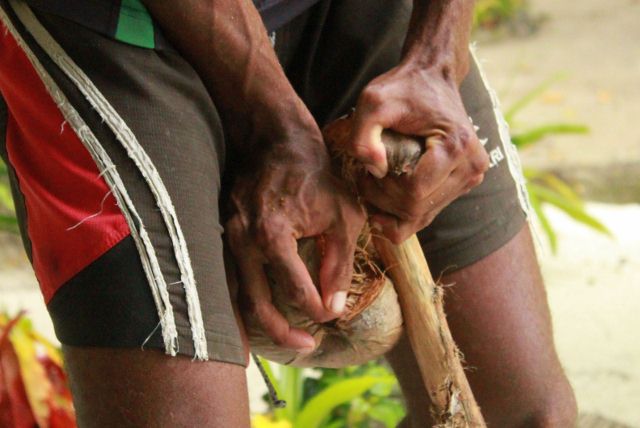
A Fijian demonstration of how to get into those pesky brown coconuts
The backdoor to paradise turns out to be the warm waters of the South Pacific. When Dutch explorer Abel Tasman first sailed into Fijian waters in 1643 he must have checked his pulse to make sure he hadn't died and gone to heaven. He saw emerald green islands bursting with lush tropical forests rising up from sapphire waves like enormous sea turtles basking in the golden equatorial sun. Brown skinned natives, unencumbered by clothes, dove for fish in the crystal clear sea or plucked sweet fruits from the trees.

With these abundant resources, it's nearly impossible to go hungry in Fiji. And like their biblical forebearers, the inhabitants of these verdant, oceanic island jewels also had some rather peculiar eating habits. But the Fijian's tastes were slightly more visceral in nature; think canibalism. That, along with the fierce warrior traditions of the Fijian people, kept European sailors and settlers at bay for the next hundred years or so.


Molly and I arrived in this other Eden under the cover of darkness after a long and much delayed flight from Los Angeles. Our flight landed in the city of Nadi on the large island of Viti Levu. The next day at dawn we boarded a large, yellow catamaran bound for the Yasawa islands, a sparsly inhabited archipelago northwest of the main island.


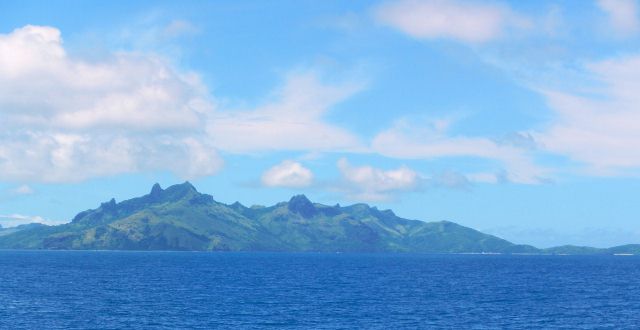
Along the way we passed dozens of islands, some as small as thirty yards across, most of which had small resorts on them. 


At one point I looked around and counted 35 distinct islands in sight and countless other looming blues shapes in the distance that might have been islands or perhaps just large clouds, it was hard to tell. After a few hours of sailing, the catamaran was met by a small motorboat that took us to our hut on the tiny island of Matacawalevu, just a few minutes from where a topless Brooke Sheilds frolicked in the waters of The Blue Lagoon and a bearded Tom Hanks made friends with a volleyball when he was a Castaway.

The Yasawa Flyer catamaran in the distance

A typical Fijian Bure
Our hut was everything you would expect from a remote tropical paradise. It was situated right on the beach shaded by coconut, mango and papaya trees. Out front, a hammock swaying gently in the island breeze practically begged to be cast in a Corona commercial. Although it lacked certain modern conveniences like electricity and hot water it was about as close to perfection as you can get.  

A tiny visitor in our hut


That afternoon we went snorkeling. We had to wait until high tide because at low tide, the water in the strait between our island and the next island was very shallow and VERY warm, probably around 85 or 90 degrees. High tide brought deeper waters and cooler temperatures (around 75 degrees). We decided to take our brand new waterproof/shockproof digital camera to get some pictures of the local sea life. We bought it specifically because it was supposed to be rough and ready for scuba diving and underwater fun.  


We swam around and took pictures for about 45 minutes and then IT BROKE. This was the first time we used it. We didn't drop it or do anything wrong. It just stopped working. We worked it out and for the price, the camera cost about $8 per minute. Thanks a lot Nikon!  

All bitching aside, we did get to see some amazing  sea life--- from bright orange clown fish swimming in their anemone homes to a giant royal blue starfish hiding under delicate branches of coral.


The next day we took a sea kayak across the strait to the island of Yaqeta. As we were crossing, a giant sea turtle surfaced right in front of our boat. Its shell must have been three feet in diameter. It looked at us for a moment with its huge black eyes before disappearing beneath the waves.

On Yaqeta we sunbathed, collected shells and waded through tide pools.


At one point an island native came strolling out of the jungle holding a 3 foot machete. It was startling at first but he greeted us with a broad smile and friendly "Bula!" (Hello). From behind him, his four children burst through the trees and ran headlong into the water, laughing and splashing. 

Small boy/Biiiig knife
It should come as no surprise that Fijians are some of the happiest people on earth and are very interested in talking to visitors although they are very isolated from the outside world. And although they are isolated, they still seemed to know a bit about the US. 
Him: Where are you from?
Me: New York City.
Him: Is that close to Los Angeles?
Me: Not exactly.

The next few days were spent lounging, swimming and kayaking all over the island which makes for great vacationing but rather boring blogs. (How many times do you need to hear me say "And then I poured some rum in a coconut and took a nap in the hammock"?)

Who wants an OYSTAH?

On our final day we hopped into a boat with some of the locals and went to church on the other side of the island.
The boat ride to church
 On an island with a population of about 200 people, about 150 of them were in church. Everyone was decked out in their finest Fijian garb (it was exactly like a Hawaiian garb, but in Fiji) so that the congregation looked like a rainbow of flowers had exploded all over the inside of the building. There was at least one child for every adult at the service and since everyone was related to eachother, the children would simply wander around smiling and jumping into people's laps for a little while before getting up in search of a more comfortable lap. 

The most beautiful part by far however was the singing. The songs were all multi-part harmonies with the angelic sopranos of the women rising delicately above the booming bass of the men. No one had hymnals or books so all of the songs were sung from memory. It was a truly wonderful.

One thing that struck me while in Fiji, aside from the extreme beauty, was how seriously they take the problem of global warming. Everywhere you look there are signs; "Don't waste water, reduce our carbon foot print" and "Turn off the lights, help eliminate greenhouse gases".  There are no idiot reporters from Fox News trying to confuse the issue by saying there is not enough evidence or that our economy cannot withstand a change to a more ecologically sustainable model. This is the front line of climate change. As the mercury shoots up, rising ocean temperatures will spawn more and more destructive tropical storms. Fortunately for us, our trip to Fiji had beautiful wather, but unfortunately for the Fijians that week was bookended by two cyclones that battered the islands and left many areas damaged and flooded. Furthermore, most of these precious islands are only a few feet above sea level. As the global ice caps melt and sea levels rise, more and more of these places will be swallowed up by the ravenous Pacific Ocean. We have reached a tipping point in history where decisive action can cause positive changes. Unfortunately, if we do nothing, this place will slip slowly beneath the waves and paradise will once again be lost.


Tuesday, January 24, 2012

South American Epilogue- The Christmas Miracle

As we headed back to the USA from South America, we had our hands full with everything we had been carrying for the past four months, as well as the huge bag of presents that we brought home to give to our families as Christmas gifts. The bag we got to carry the presents was typical of South America. It was a bright, multicolored woven plastic bag with a bunch of Spanish words and a picture of the Lion King on it. Turns out, what is typical in South America doesn't even exist in North America. Because of it's important contents, and it's ridiculously bright exterior, we kept a close eye on that bag of gifts. After travelling with the bag for almost 3000 miles (Quito to Panama City to Orlando to New York to Boston), it had become an extension of myself. Until we put it down on the curb outside South Station, to load our other bags into the car.... and left it there.

We didn't realize that we had left the bag until almost 11 o'clock that night, at which point it was too late to go back into Boston to look for it. Bill Waterhouse, always a man with ideas, suggested that we head back into Boston the following morning to check the lost and found at South Station. After all, it was Christmas time. People have a tendency to be kind at that time of year.

When I arrived at South Station, I realized that each of the different sectors of the station have their own lost and found. So over the next half an hour, I checked in with the lost and found at the bus terminal, the commuter rail and at Amtrak, but to no avail. I was feeling quite demoralized as I walked by the entrance to the Red Line subway. I figured it was a long shot, but I might as well check to see if they had a lost and found.

As I got to the bottom of the stairs, I saw an area with transit workers and asked one of them if there was a lost and found. He told me I would have to go to another train station to check the lost and found there, which, at that point, I did not want to do. I was ready to head home in utter defeat, but then something caught my eye. 

In a wire basket in front of the transit office was a bright, multicolored bag. Having just spent four months in South America where EVERYONE has that exact bag, I immediately thought, "Huh. I guess someone else has the same bag." I walked over to the basket and asked the transit worker about the bag. He practically screamed at me, "What do you know about this bag???" 

I told him that I thought this was the bag I was looking for, and as I reached in to pull the bag out of the basket I saw the tell-tale Lion King on the back side of the bag. As the realization dawned on me that this was my bag, another transit worker came out of the office and started yelling. He demanded to know what I knew about the bag, how I knew it was here and what I had to do with all of this. I explained to him that I accidentally left the bag on the sidewalk last night, but that I'd like to take it home. Not so fast, he told me.

He opened his cell phone and showed me a picture of a make-shift table and proceeded to tell me the story of my missing bag. At some point the previous night, someone took the bag from the street and brought it down into the subway. They removed all of the contents and set up a display on the subway platform. He displayed the table runners that Mark and I bought for our moms, the silver and mahogany tray, the blanket I bought for my sister-in-law, a bowl for my dad and a few other things... and he tried to SELL THEM! 
Fortunately for me, this person tried to be slick and set up the table just outside the line of sight of the security camera. Somehow, the transit authority had been alerted and found this man's activity to be extremely sketchy. So sketchy, in fact, that they called the bomb squad in to investigate. The bomb squad had finished about 10 minutes before I arrived in the station. 

As he was telling me all this, I was looking through the basket and realized that every single gift was still there. Not one gift was missing. As he finished telling me the story of my bag, I burst into tears and started screaming at the top of my lungs, "IT'S A CHRISTMAS MIRACLE!!" In that wonderful, gruff Boston way, the two transit workers kept saying, "Lady. Calm down, lady. Lady. Stop crying, lady!" I got the sense that they were going to detain me and try to find out more from me about this bag, which had caused so much trouble, but they couldn't calm me down from crying and screaming about the Christmas miracle. I think they were just happy to get me out of there. 

As I collected my things and put them all into the bag to take home, I looked up at the transit worker. "Who would do something like that?" I asked. "Oh, you know these subterranean people." I guess I do now.

So, THANK YOU subterranean people (or Mole People, if you prefer) for stealing my stuff, trying to sell it, and getting the bomb squad to make sure it was all good so they could return it to me, just in time for Christmas.