Your Fearless Travelers

Your Fearless Travelers

Saturday, September 24, 2011

Machu Picchu-Tales from the Trail

Tales from the Trail
Because the Inca Trail is so popular with tourists, Peru limits the number of permits that they issue and requires that all trekkers hike with a tour company. Anyone who shows up in Cusco and tries to book the trek for the following week is told they are out of luck. We booked last April, so on Monday morning (at 5:40AM) we were good to go. The bus picked us up and drove us to the trail head which is about 2 hours from Cusco. 


We hiked for the better part of the morning, beside a raging river and past a few Incan ruins. The porters, who were carrying the tents, food and all the equipment, ran ahead down the trail and set up for lunch before we arrived. As we ate a delicious spread of avocado salad, chicken soup and grilled trout, the rain started. We hiked in the drizzle for the rest of the afternoon, until we reached this bar. 

...where everybody knows your name. SPOILER ALERT: It's Gringo.
Although it's hard to tell that this is a bar, the stick with the red plastic bag signifies to passersby that this is the place to drink. And the drink of choice? Chicha, an alcoholic beverage made of fermented corn, which is brewed in a large pot.

Yummy!
 It looks, and tastes, a lot like yeast. The Andean people have a tradition to pour some of the chicha onto the ground before they drink it, as an offering to Pachamama, the goddess Mother Earth. Another Andean tradition is the gratuitous use of coca leaves. People high up in the mountains swear by its medicinal properties, saying that it reduces the risk of altitude sickness, increases your energy and curbs hunger. Go figure. The coca leaves are chewed in the side of your mouth, between your cheek and your gums, with a bit of charcoal to release the alkaloids of the plant (or so I'm told by Mr. Science... I mean Mr. Stratil). The Andean people believe that coca leaves are the food of the gods, and that we must ask permission to chew them. Before chewing the leaves, our guide told us to give an offering of 3 leaves to Pachamama, and thank her for the coca leaves and for all the beauty on earth. So we did.


We hiked for the rest of the afternoon to reach our campsite, which had already been set up by the porters. Hot coca tea and snacks were waiting for us, and dinner was served around 7. We went to bed early, listening to the gentle yet demoralizing sound of the rain hitting our tents. As Hemingway said, "The rain was making the finest sound that we, who live much outside of houses, ever hear. It was a lovely sound, even though it was bitching us." In the morning, it had cleared a bit and we got up and started hiking around 6:30. The second day was to be the longest and most difficult day, with 15 km (9.5 miles) to hike and 1200 meters (about 4000 feet) to climb. We had a second breakfast, or elevensies, at a break in the trail. And then the rain started again. Virtually everyone on the trail had purchased cheapie ponchos in Cusco, in a variety of colors. (Turned out to be the best $2 we have ever spent!) But the effect was that we looked like a tribe of multicolored gnomes hiking up the hill. 


We climbed up, up, up the stairs, through the valley to Dead Woman's Pass at 4215 meters (13,780 feet). 

My green gnome at Dead Woman's Pass
After the pass, we had a beautiful and less brutal downhill climb to the campsite. We settled in to our tent and enjoyed some well-deserved rest for the afternoon. Having been on the trail before, I knew that there is only one thing that you want to eat after a long day of hiking. Snickers. So we brought 6 of them. One for each of us for each of the three long hiking days. We affectionately called that time of day "Snickers Time." 

It's actually pronounced "Sneeeeckers Time" 
That night, the clouds cleared while we ate dinner. As we walked out of the dinner tent, we saw millions and millions of stars. The sky was so clear that we could see not only the Milky Way, but we could see the dark spaces within the Milky Way (apparently that is really interesting). The sky was pretty spectacular. 
We slept well that night and woke up ready for another day of hiking. After a short climb, we arrived at the first of many Incan ruins that we would see that day. Our guide told us to carry a rock from the site to the pass so that we could offer it to Pachamama. When we arrived at the second pass (3950 m/12,900 ft) we held a simple ceremony for Pachamama. We offered the rocks, three perfect coca leaves and something that was significant to us and in return, we asked Pachamama to grant us one wish. Most people offered different kinds of foods that they coveted---coca candies, Milano cookies, chocolates etc. No, I did not give up one of my Snickers bars. I gave her 2 peanuts and a raisin. Actually, I dropped one of the peanuts. Despite my crappy offering, she treated us well and granted the wish that I'm sure every single person made at the ceremony:
 "PLEASE- NO MORE RAIN!!"

Mark's offering
After the pass, we continued the hike through the cloud forest, which is effectively a rain forest but with clouds instead of rain. Well, sometimes both. Lucky for us, the rain held off.


After lunch came the dreaded Gringo Killers, a 1000 meter descent on stone stairs. On the way down the stairs, through the cloud forest, we saw lots of flora and fauna, including 4 different kinds of bamboo, two toucans and a deer.


At the end of the Gringo Killers was an Inca site, called Winayhuayna, nestled on a hillside which was once used for agricultural cultivation. It resembles a giant beehive on the side of the hill. These days, the hill is mostly used by the llamas. Careful, they spit! And shit!

That one in the distance looked at me funny.
We arrived at our campsite around 5 and relaxed until dinner. We went to bed early, because the next morning was the final push for Machu Picchu. The wake-up call was to be at 4AM but we hardly slept that night, listening to the rain hitting our tent, thinking that our worst fear- Machu Picchu in the rain- was about to be realized. When it was light enough to see, there were only clouds. The beautiful mountains we had seen the night before had disappeared in a white mist. We had to stop at a check-point about 5 minutes from the campsite. Of all the trekking groups, we were the last to arrive. Everyone waited until 5:30 for the checkpoint to open. While we waited, the rain started. Slowly at first, then harder. Now back into our gnome outfits, we started the hour and a half hike to the Sun Gate, the vista point where you can see Machu Picchu for the first time. The idea is to get there by 7 so that you can see the sun come over the mountains. Even though we knew we wouldn't be able to see anything once we got there, it didn't matter. They group was going to make a run for it. The only word to describe the hike is frenzied. We literally ran down the path, up the Inca steps, and then back down for a solid hour. Some other trekkers were not so happy to be passed by the running gnomes, including one particularly surly old man who shoved a member of our group. As people stopped to catch their breath or get some water, we pressed on and made it to the Sun Gate just before 7AM. And we saw......
NOTHING. 
Nada. 
Zip.


With a quiet curse to Pachamama, we headed down the steps on our final descent toward Machu Picchu. But then, as we arrived at the top of the hill overlooking the ruins, she finally smiled down on us. The sun broke through, and we were able to see Machu Picchu in all it's glory. And glorious it was.


There is really no way to explain how majestic Machu Picchu is. From the mystery surrounding it's creation and the disappearance of the Inca, to the incredibly preserved stone structures, to the scientifically advanced nature of the buildings, we were awestruck. In 1400AD, the Incan people had the foresight to construct their buildings on rolling marbles, which is the newest anti-seismic technology now used by cities like San Francisco. They also built some structures on a 13 degree inward incline to push the force of the buildings outward so that they would not topple during an earthquake. And that is to say nothing of the sheer size of the place. Pictures could never do justice to the immense beauty of Machu Picchu.


I was tired from our 4AM wake-up call, so I took a little nap. Don't judge me- I'm sure many an Inca did the same. 


Monday, September 19, 2011

Beauty and Destruction in the Andes: Huaraz & Caraz, Peru

There must have been at least seven or eight guys on him.  All of them were crowded around in a tight pack making escape impossible.  In the center of the melee a lone Peruvian with dark skin and dirty black hair held his hands up to his face, attempting to ward off the random blows that the cluster of other locals were raining down on him.  The pack slowly moved down the street. Every five or six seconds one of the gang would throw a haymaker or open handed slap, never enough to drop the unfortunate recipient, but enough keep him dazed.
   It was 7AM and Molly and I had just gotten off of an all night bus that took us from the coastal city of Trujillo to Huaraz, high in the mountains. Still rubbing the sleep from our eyes, the fray unfolded in dreamy slow motion. All around in the street other locals half-watched while going about their morning routine.  Apparently the effects of alcohol on the indigenous population are well-known to the people of Huaraz and they looked on with mild disinterest.  Not wanting to get involved, Molly and I walked down the street in search of our hostal, leaving the ruffians to settle their dust-up in their own way,
   Huaraz, named for the Quechua word for dawn, is nestled in the mountains about 10,000 feet up in a range of the Andes known as the Cordillera Blanca. The Cordillera Blanca is home to the highest mountains in the world, outside of the Himalaya,s and the beautiful, snow crested peaks look down on the little city from every direction.

    After finding a hostel, we decided to acclimatize by taking a hike up into the hills around Huaraz. The path slowly lead us through the outskirts of town.  The streets were choked with outdoor restaurants cooking up all manner of mountain delicacies. Fried chicken, roasted guinea pig and bubbling pots of stew perfumed the air with their heady spices as we wound through the narrow streets.  
     Just beyond the city we came upon the ruins of Waullac. Dating to about 600AD in pre-incan times these buildings were constructed by the Wari people.  The site houses about five or six structures surrounded by small hollows dug into the earth.  Archaeologists believe that these were ceremonial burial sites of important members of the tribe.  We wandered through the ancient buildings for an hour or so eating apples and speculating about the people who had built them before continuing higher into the hills. 
Molly outside one of the ruins at Waullac.  It doesn't look so bad considering its 1,400 years old.
     Our destination for the trek was a tiny village high in the hills called Marian.  Because we had no map or guide to show us the way we had to ask people we met along the trail.  Everyone we met was wonderful and full of life, wanting only to talk to us for a moment and help us along the way.  At one point we ran into a tiny, wisp of a woman carrying a bundle of firewood at least twice her size.  She must have been in her seventies with dark brown, paper-like skin that creased and folded around her bright darting eyes.  She seemed delighted to see us. "Hola gringita y gringito!"  She exclaimed, laughing and waving at us. We spoke for a few moments, only understanding half of the words that came out of her toothless mouth, but laughing the whole time.
"Hello little white girl and little white boy!"
      The village of Marian was another half hour walk up the hill.  We passed tiny farms across which fires burned in the straw colored grass, set by the farmers to fertilize the land for the upcoming planting.  Sprawling alpine meadows fed herds of grazing cattle, pigs and llamas. We finally reached the village right in the middle of a soccer match.  Although the action was broken up a few times when some cowherds walked their animals across midfield it was a thoroughly enjoyable game.

     Before dawn the next day we set out in search of hot springs to sooth our weary muscles.  We found them in the town of Marcara. The springs themselves were a scalding 118 degrees and too hot to sit in.  Fortunately there was a different attraction at these thermal baths, steam caves.  Built into the side of the hill, ten doors cover the entrances to tiny caves about ten feet deep and six feet high.  Inside each cave a thermal vent releases a jet of steam that super-heats the air inside.  After fifteen minutes of relaxing in this natural sauna, I felt like my muscles were made of pienapple jello (a very popular snack here).
Too hot in the hot tub!
That evening we caught a minibus up to the small town of Caraz.  Leaning my head out the window, I took in the full beauty of the countryside.  The thin mountain air was filled with the scent of eucalyptus and wood smoke.  Great stands of these trees stood out dark green against the jagged mountains and above everything mighty Huazcaran, the highest peak in Peru, looked down like a snow hooded monk in silent meditation.
     Early the next morning the time had come for out first real hike. To get to the trailhead we had to pass through the town of Yungay, or I should say New Yungay. The mountain monks are not always so silent.  On May 31st, 1970 an earthquake triggered a massive landslide. Fifty million cubic yards of rock fell from the north face of Huazcaran into the valley below. Traveling at 250 miles per hour it buried the town, killing 25,000 of its inhabitants. Only 92 people survived.  The Peruvian government has forbidden excavation of the site, declaring it a national cemetery. 
    Moving past new city of Yungay we made our way into Huazcaran National Park. Our destination was a glacial lake about 14,800 feet above sea level called Lago 69.  The lake is famous for its unearthly blue color which it owes to the rich mineral content of the water flowing out of the glacier above.  The first part of the hike wound us through a wide valley with a swift running mountain stream flowing through the middle.  Twisted polylepis trees dot the landscape providing shade for the horses that grazed on the short grass.
  
   About a mile and a half later we reached the edge of the valley and began to climb, and climb, and climb.  As we ascended several thousand vertical I was struck by the way the vegetation change.  The scenery ran the gamut from sun baked desert to freezing glaciers and everything in between.  After hours of hiking we finally reached Lago 69 in the late afternoon.  The sight was nothing short of breathtaking. About 500 feet above the lake perched on the edge of a sheer rock face, the glacier spit out a delicate waterfall that cascaded into the azure waters below.  Every few minutes a sound like a thunderclap echoed through the valley as the splitting ice of the glacier creaked and cracked its way along the side of the mountain.  We stayed at the lake for about an hour and had lunch before the altitude began to take its toll and we started the long hike back to the trail head.


   We had no real plans for getting back into town.  The locals had said that many cars passed by on the way to Yungay so when we got to the road we just stuck our thumbs out and hoped.  Within minutes a rickety old fruit truck came bouncing down the road.  The driver agreed to take us into town for five soles (about $1.60) and since there was no room in the cab, we hopped into the back. The truck shimmied and shook while we held on for dear life for the entire hour and a half trip back into Yungay (plus a twenty minute stop at the drivers house to help him unload some produce).


   The next day we took a day hike in the hills around Caraz up to a small hamlet called Pueblo Libre.  The area is much lower than Lago 69 and reminded me of the desert around Santa Fe, New Mexico.  Golden red and orange hills were dotted with small trees, scrub brush and huge blue agave cacti.  Molly and I mused about the idea of opening up a tequila factory and retiring.  It wouldn't be a bad life.
TEQUILA!
   Later, as we boarded the night bus for Lima, I thought about the Andes and the folks we had met.  They  are a land and a people with two faces.  One of the is beautiful, wondrous and inviting that welcomes visitors with open arms.  The other is terrible and destructive in its wrath.  It is easy to get caught up in the spectacular, postcard panorama of the mountains and ignore the awesome power that lies beneath.  Similarly it is easy to become enraged at the business owner who tries to rip you off  and overlook the incredible warmth and curiosity that permeates the people of this land.  These two faces are different sides of the same coin and spring from the same source.  There would be no beauty without destruction in the mountains and there would be no warmth nor treachery without tourists. Woe be to the traveler who becomes transfixed on one face while ignoring the other. 


Friday, September 2, 2011

Ole! That's Spanish for... Ole!

WARNING: THIS BLOG POST WILL BE GRUESOME! 
You've been warned.

On Tuesday, Mark and I had the afternoon off at the orphanage and we went into Trujillo to see our first bullfight. Well, it wasn't much of a fight. 
Spoiler alert: The bull lost. 


Not sure how many of you are familiar with what happens at a bull fight, so we'll give you the run-down. First, Superman and Little Black Sambo came into the arena. 

Holy racism, Batman!
Next, the matadors-in-training had an opportunity to strut their stuff. Because they were only training (and they couldn't have been more than 15 years old) they went up against a cow instead of a bull. The cow, however, was incredibly feisty. In this video, the mini-dor tries to look like a tough guy (which is hard to pull off in the outfit he's wearing) and taunts the cow. It did not go well.


The real matadors finally arrived and shook hands. The first matador was visiting from Spain and the second  was the hometown favorite. Our initial reaction was, "Wow! A bullfighter from Spain! This is going to be the real deal." Oh, how wrong we were. 

Fancy Pants
Before the matador contends with the bull, people called picadors come out and stab the bull in the back of the neck. This causes the bull to charge with its head down, allowing the matador to get a clear shot at the back of the bull's neck. The idea is that with one sword plunge, the bull is killed instantly. That's the idea, anyway. Unfortunately, (for us and for the bull) the Spanish matador really sucked at his job. After dancing around with the bull for about 15 minutes, it came time for the lethal blow. But it wasn't lethal. Nor was the second blow. Nor the third, fourth, fifth of sixth. What we witnessed was basically the bull being hacked to death. Oh, and there was blood pouring out of the bull's mouth, as well. The crowd was not impressed and started throwing bottles at the matador. The matador didn't seem to care and after the bull was dead he proceeded to do a 10 minute victory lap around the arena. He was strutting about like he was cock of the walk. But let me tell you something, the Spanish matador was cock of NOTHING.
(I'll spare you the 3 minute video of the first bull's death)

Next, the matador from Trujillo came out. He was actually quite impressive. 


This matador was much more skilled at murder and took the bull down with one thrust (and one head stab). Actually, the bull ran around for a bit before he fell down, but it was... well... less horrible. See for yourself.
 (Remember, you've been warned!)


There you have it.
 The good, the bad and the ugly of the bullfight.
(aka the pageantry, the racism and the death)
Please do not send us any protest letters. We will not be attending another bullfight. 
We promise.

Don't cry for me. I'm already dead. 

 FIN

Tuesday, August 30, 2011

It's a Hard Knock Life. Hogar de Esperanza, Trujillo, Peru

     Well,  it had to happen eventually. After weeks of eating tripe, cow stomach, chicken feet and whole sardines I have at last been felled... by a chicken salad sandwich. A curse on the vile swine who first mixed chicken, mayonnaise and hell-fire and called it a meal! From now on I'm sticking to street grilled beef hearts (which, but the way, is delicious). But fear not, gentle reader. I'm off to the Trujillo farmers market tomorrow to pick up some snake bile mixed with lime juice from the local shaman. Should fix me right up.

The offending sandwich.  Looks pretty good, right? WRONG!  Apparently the swirl on the top is an ancient Incan sign of  warning. 
     Molly and I arrived at the Hogar de Esperanza from Huanchaco a little over a week ago. It is an orphanage that houses about 40 boys and girls from age 1 to 18. The majority of the kids are elementary school age and they are ridiculously cute. As you might imagine, Peruvian orphanages are not situated on the most prime real estate.  Our immediate neighbors are a coal repository, a high density chicken farm, an oil refinery and an abattoir. (Def. Abattoir: Slaughterhouse. "The cow was slaughtered in the abattoir") When the wind is right the smell can be just... well, indescribable.
     Olfactory offenses aside, there are some pretty amazing aspects to the orphanage.  It's only about a half-a-mile from the glorious Pacific ocean. South American winter is slowly winding down so that means that the sun is coming out more and more each day. On most days, the quickly setting sun sets the sky on fire with her rosy fingers in one last act of blazing defiance just before she drops into the chilly waters and is extinguished for another day. (That's how I'm told it works, anyway.)


     The second great thing about the location of the orphanage is the sand. Just behind the compound wall, a 100 foot tall sand dune looms up out of the desert. The hike up is a ponderous undertaking as the flour-soft sand crumbles away beneath your feet, taking back about half of every step. It is all worth it when you get to the top. A beautiful panorama spreads itself out before you. The golden slopes run away from your feet, rolling over the dunes down to the wine-dark sea. (I've been reading a lot of Homer lately) But the best part of the sand dunes is sand boarding. I've included a video. I guess professional sand boarding is not in my future.

Squinting into the sun.  The great dune looms in the distance
The shifting sands are not so forgiving to all who enter them.
     Scenery aside, our days at the orphanage are spent doing various things. I've been fulfilling my inner Groundskeeper Willie by pulling weeds, cleaning windows and yelling at people with a Scottish accent. I have been giving guitar lessons to a 13 year old boy here named Abraham. He has absolutely no knowledge of either Nirvana or Guns N Roses. Needless to say, I have my work cut out for me. At the suggestion of my friend Dan, I've decided to spend the remainder of this year spreading the gospel of hard rock to all the people of the world. Look for the first installment, The Book of Zepplin out in paperback this fall!
     Although I may be rocking out, Molly is the real rock star of this operation. She spends her days surrounded by little ones. It is wonderful to see their faces light up when she enters the room. She is so patient and kind to each one of them. Every afternoon, she helps them with their homework and they are constantly inviting us over to their casitas to visit, tell stories and play music. Even though we struggle with our Spanish, Molly is such a great communicator that every word we try to express is understood.

Molly with Paul (pronounced Pa-ooool)
     When we're not in the orphanage we spend our time wandering around Trujillo.  Founded in 1534 and well fortified to defend against pirates, Trujillo has a wealth of Spanish colonial buildings inside it's historic old town.  The buildings, with their brightly colored facades decorated with intricate stone and woodwork, stand beautiful and proud among the smooth cobblestone streets.  There is a bullfighting arena just outside the old city walls that imports matadors from Spain to contend with some of the most vicious beasts that Peru has to offer.  We have not gotten to a fight yet, but it is on the list


  However, the best part about Trujillo, as with most of the cities we have visited, is the central market.  It is here that you truly get to feel the pulse of this living, vibrant city.  The major market days are Tuesday and Wednesday, when throngs of people flood into an area the size of 4 or 5 city blocks to hawk their wares. Being as large as it is, the market is divided into several different sections.  A covered area about the size of a football field is dedicated to a mix of different things, but beyond that you get into the distinct districts of the market.  There is the vegetable market, Banana Boulevard, Apple Alley, and of course Meat Street.  Meat Street is not for the faint of heart.  Skinless animals of all shapes and sizes hang from huge meat hooks as far as the eye can see.  Cow tongues, stomachs and intestines dangle over metal bars like towels drying on a rack.  To ensure freshness they even have live chickens that they will kill, de-feather and butcher right in front of you.  It's a grizzly custom, but if you can't handle it, you probably shouldn't be eating meat in the first place.

Some cows in Peru live out their days on lush green pastures, high in the Andes. These guys weren't so lucky.
A vegetable vendor in the market


I must be going now. I hear the call of the Incan god "El Porceliano". We will be staying at the orphanage for about two more weeks, and then its on to Huaraz and Machu Picchu after that.  Hopefully this blog post finds you in good health and with a strong appetite.

Saturday, August 20, 2011

The sea forgives all, unlike those mean old mountains.

     You might think that hanging out at a Peruvian surf town on the Pacific ocean would be amazing... and you'd be right. I may be showing my age by saying this (I still feel like I'm 22), but the best thing about the first day that we were here was sleeping. After a heroic bus ride of more than 475 miles all we wanted to do was take a nap. And nap we did. 13 1/2 hours of napping. Finally, after our kurzer tod  (look it up) we awoke with a powerful hunger. We walked down the beach until we found the first of many, many ceviche places that would become a hallmark of our time here. For those of you not familiar with ceviche, think of it as South American sushi;  Raw fish, shrimp and other assorted crustaceans "cooked" in lime juice and other spices.  Here in Peru it is a national obsession. Drink a beer, have some ceviche, go surfing, have some ceviche, too much fish?... have some ceviche. It is amazing.
     After eating we ambled through the streets of town to get the lay of the land. The northern Pacific coast of Peru is essentially a desert and Huanchao is where the desert meets the sea. Sand surfing is almost as popular as regular surfing. Eventually we found ourselves at the local cemetery. The silent, home-made crosses outlined against gray and cloudy, desert sky made for a haunting image.
     The next day we made a breakfast of eggs and toast then headed into the main city of Trujillo.  We took the bus which was and adventure in itself.  The short story is that they were all made from old washing machines, filled with pickpockets and covered in pornography and pirated cartoon characters.  Needless to say, I felt right at home. In Trujillo we bought a guitar. FINALLY!  I've been jonesing for a a guitar ever since we landed on this continent and it finally happened. It's cheap but it has 6 strings and a sound box which is all I'm looking for.
That is a ceremonial scepter I'm holding.
Get your mind out of the gutter.
     On the way back from Trujillo we stopped by the ancient ruins of Chan Chan. Practically unknown to the outside world, Chan Chan was actually the largest pre-Columbian adobe city in the Americas.  It was over 20 square miles of adobe structures 30 feet high perched next to the Pacific ocean. Most of the city is in horrible shape now and kind of looks like a giant, crumbling Pac Man game made of sand but parts of it have been restored. It even has it's own Disney-style inhabitants who are more than happy to take your money in exchange for a photo.

    We arrived at the tomb of the king of Chan Chan before long and decided to give a small concert for the departed.  I hope the Chimu Indian ghosts like Pink Floyd's "Wish You Were Here"  because that's what they're getting: 


   We eventually made our way back to Huanchaco, and you know what? Peruvian people love guitars! We couldn't walk five feet without a horde of people stopping us and asking us to stop and play songs for them. We eventually stopped and hung out with a few street vendors who danced, hula-hooped and played the flute along to Beatles, Bob Marley and Judge Roy Bean songs.                                                                      That night we saw our first sunset over the Pacific ocean.  Although there are no "seasons" in Huanchaco (it is 8 degrees south latitude) there are two distinct types of sky.  From November to June the sky is beautiful and clear all day.  From late June to October Huanchaco becomes the land of eternal clouds. Fortunately, for one brief, shining moment a tiny break in the clouds appeared right at sunset giving us a gorgeous panorama.
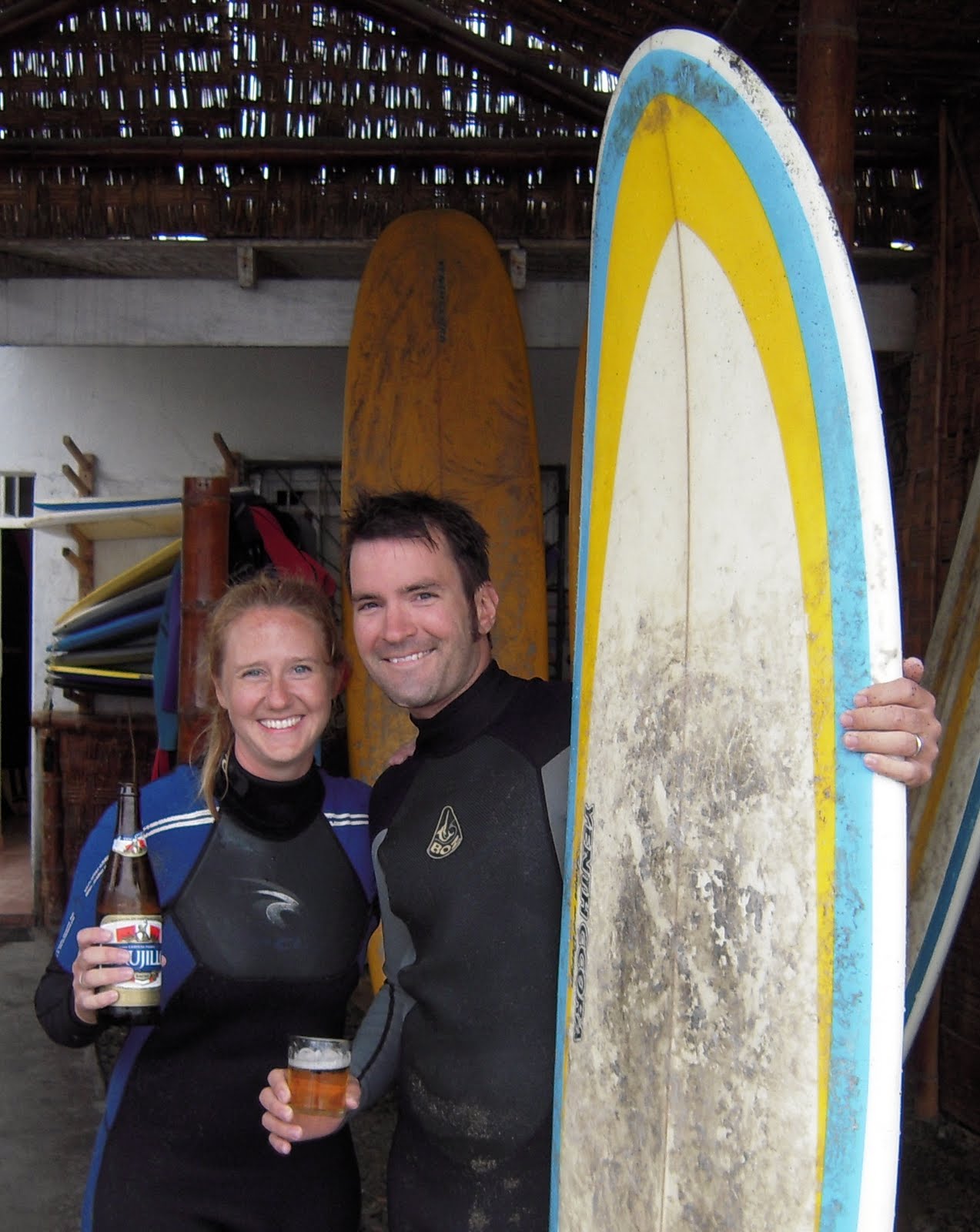
     Surfs up! Friday rolled around and we finally decided to get our feet wet and do a little surfing.  The water was chilly due to the Humbolt current which runs up the side of South America bringing with it the icy waters of Antarctica. The waves were pretty decent and Molly and I both had a few good rides. After two and a half hours we were wiped out and headed in.  
     We had rented boards and wet suits from a CRAZY party guy at a shop right on the beach.  It turned out that not only did he design and make all his boards in a little back room behind the shop, but it was also his birthday.  Before we could say anything he shoved a couple of beers in our hands and cranked up the music.   A bunch of his friends were already there drinking and shouting.  It was our first, but probably not last, South American fiesta.