Your Fearless Travelers

Your Fearless Travelers

Tuesday, November 8, 2011

Among Sleeping Giants. Puerto Varas, Pucon; Chile


Of all the displays of nature's wrath, there is perhaps none more incredible than a volcano. To ancient peoples, they were gods and gateways to other worlds; to geologists they are a chance to glimpse the primordial forces that forged the earth; and, if you're a scientologist, they are the places where the galactic overlord Xenu stashed the souls of dead aliens that now cloud our minds and dampen our potential. In Italy, Mount Vesuvius acts as a time capsule with the ash from an eruption perfectly preserving the daily life of an ancient Roman city while in 1815 Indonesia's Mount Tambora erupted so violently that the ash blocked the rays of the sun, lowering global temperatures and causing famine all over the world. No matter your view of volcanos, it is impossible to deny their might, their beauty and their destructive power.

The entire length of Chile lies along the the Pacific rim's "Ring of Fire" (cue Johnny Cash) so volcanoes abound. The country is at once indebted to and held hostage by these smoking behemoths. Volcanic soil is some of the most fertile on earth helping to make Chile an agricultural powerhouse, filling shelves of grocery stores from Bangkok to Barcelona. Their natural beauty has for years been a beacon for thousands of tourists from all over the world, who bring millions of pesos to the local economy. But, of course, there is a darker side as well. Like the sword of Damocles dangling overhead, the volcanoes of Chile constantly threaten to wipe out the prosperity they have given. Thousands of lives and billions of dollars have been lost to eruptions over the years and every local has an escape plan in case the mountains rumble awake. With this in mind Molly and I decided to go out among these sleeping giants to see their awesome majesty for ourselves.

In case of eruption- run away!
We traveled north from Chiloe to the town of Puerto Varas on the shores of Lago Llanquihue. During the 19th century German immigrants settled this region and left an indelible mark on the architecture, landscape and culture. The town looks like it was plucked right out of the Black forest. Peaked roof houses and neo-romantic churches line the broad streets that lead down to the lake. 

Volcan Osorno is obscured by ash falling from another volcano a few hundred miles away
This is what it SHOULD look like
As luck would have it we arrived just at the beginning of one of the greatest festivals that German culture has given the world... Oktoberfest! 


Two beer enthusiasts
The entire downtown area was decked out in German flags. In the central square a huge tent had been erected to house the beerhall. Beneath the tent the air was filled with the smell of roasting sausages, oompah music and the laughter of revelers as they sampled the fare. The real star of any Oktoberfest though is the beer... and it flowed like water. Fifteen different breweries from around the region had stations set up giving out samples and selling huge steins of good, German-style beer. Being on a tight budget, Molly and I had been subsisting on box wine and cheap, watery cerveza for the past few weeks so this brew was like ambrosia. We drank deeply while eating our fill of bratwurst, knockwurst... basically any kind of wurst we could get our hands on.

A few days later we set out for Vincente Perez Rosales National Park. The park is Chile's second oldest, home to many volcanoes and surrounding the broken, lake/road/lake/road/lake trail between Puerto Montt and Bariloche, Argentina. This is where Che Guevara crossed over into Chile as seen in The Motorcycle Diaries. The western part of the park is dominated by the massive snow covered peak of Volcan Osorno. The volcano is an almost perfect cone shape and makes an imposing silhouette above the waters of Lago Todos Los Santos. 


The lake itself is tranquility embodied. Crystal clear waters are surrounded by steep hills covered in fragrant pine forests. Snow-capped peaks rise dramatically in the distance everywhere you look. We hiked for a few hours along the lake shoreline seaching for a place to camp, and we found one. 


At the edge of a long black sand beach, against a high cliff covered by a tree jutting out over the lake we found our spot. Sheltered from the wind with an eastern exposure for the morning sun, it was just perfect. We built a fire that evening and roasted potatoes and sausages while watching the mountains change color with the setting sun.


The next day we hiked along the Rio Petrohue. The river drains glacial water from the lake. Until I saw the Rio Petrohue I never thought rivers could be blue. This one is BLUE, like, Disney-World-Pirates-of-the-Caribbean-dyed-with-food-coloring blue. It is extremely beautiful. Hidden flyfishing spots abound, as do some world class rapids. We had lunch on the riverbank before heading back to camp.


The next morning we awoke to what we thought was a gentle rain tapping on the tent. We unzipped the the flaps to find a scene out of Cormac McCarthy's The Road. Thick, dark clouds covered the sky as ash fell like gentle snow over the entire park. A volcano named Puyehue, a hundred miles to the north, had been erupting since March and this day the winds had shifted the dust cloud in our direction. The once crystal clear waters of the lake were now blackened and covered with an oil-like sheen. Our throats and eyes burned from the ash as we packed up our belongings. I even had to cover my face with a wet bandana to keep from choking. It was definitely time to go.


We jumped in a bus and after a quick stop in the city of Valdivia, we found ourselves in the mountain town of Pucon. If Puerto Varas is the Germany of southern Chile, then Pucon is definitely Switzerland. High mountain peaks cradle lush green valleys. The town itself is nestled beneath the active volcano Villarrica. A tiny plume of smoke perpetually rises from the crater at the top. It is the only active volcano in South America where you can actually hike to the summit. Dozens of other volcanoes dot the landscape around Pucon.


We settled into Pucon very quickly. Our hostel "Casa Mario" is run by some of the nicest people we've met on our trip. The owner Luis (I don't know were Mario ran off to, possibly down a sewer pipe or chasing a mushroom) and his wife were extremely helpful. They showed us local points of interest and did our laundry for cheap. They even gave us free bikes to ride around on for the day. 
We rode those free bikes up to a beautiful set of waterfalls called the Ojos de Caburgua. Three rivers come together and fall into an azure pool. Like Rivendell, fabled home of the eleves, the Ojos de Caburgua has an other-worldly beauty that is hard to put into words. The waters begin in high glaciers on the peaks of volcanos, another gift of these geothermal giants. They then run into a huge lake called Lago Carburgua. They exit the lake through underground caves and where they emerge again miles away from springs deep in the earth. The sweet liquid is icy cold and actually bottled and sold by the locals as mineral water. It was all I could do to keep from diving in for a swim.


As we rode back to Pucon I was struck again by the astounding beauty of the countryside. Emerald green pastureland gave way to jagged mountains covered in trees. Small groups of glassy-eyed cows lazily chewed cud among yellow buttercups as placid alpine lakes reflected the blue skies like giant mirrors. High above the valley the snow-capped peaks, like silent guardians, watched over the peaceful scene. Only the gauze-like wisp of smoke rising from the crater of Villarrica hinted that all this beauty could be wiped out in an instant. 


Friday, October 28, 2011

Forgotten Patagonia: Chiloe Island, Chile


For most travelers in southern Chile, the island of Chiloe is a mere stepping stone to lands beyond. Lying on the northern edge of Patagonia it is easy to overlook the tranquil, emerald landscape while setting your sights on the wilder and more exotic destinations at the end of the continent. Many see Chiloe as simply the last port of call before embarking on the long ferry ride down to Torres del Paine near the straights of Magellan, at the end of the world. However, those few souls who do decide to explore this tiny, forgotten corner of Patagonia will find rich and diverse lands full of uninhabited wilderness, warm, friendly people and some of the freshest (and cheapest) food the sea has to offer.


We arrived in the small fishing town of Ancud on the northwest shore of Chiloe after 29 hours of traveling from La Serena. Our trip included three buses, a ferry ride and a little tear gas to boot from a demonstration we'd been caught in while stopping in Santiago. Needless to say we were tired. After procuring a hostel and taking a quick siesta, we decided to hit the town.

It was windy.


It may be a bit surprising to those who have never traveled in South America, but the west coast of Chile is actually like a mirror image of the west coast of North America. In the north of Chile lies the Atacama desert which corresponds to the deserts of northern Mexico and Baja, California. Moving south in Chile you eventually run into the central valley around Santiago which is the heart of Chile's agricultural and wine producing region, similar to the vast vinyards and farmland of central California. Continuing with the analogy, the lakes district and Chiloe are the "Pacific northwest" of South America. It seems to fit this description perfectly.

Wildflowers in Chiloe
The country side around Ancud, the northernmost town of Chiloe, features rolling green pasture land broken up by vast tracks of evergreen and eucalyptus forests. Rocky cliffs tumble down into the frigid and turbulent waters of the Pacific Ocean. Much of this part of the world was covered in ice during the last ice age and the retreating glaciers left a jagged, wild shoreline full of deep fjords, steep hills and tiny islands in every direction you look. 


The town of Ancud itself has a feel very similar to many small towns that dot the coast of Oregon or Washington state. A cluster of multicolored, ramshackle houses stand along a zig-zagging streets above the port, each with a perpetual whisp of smoke cheerfully puffing out of the chimney. It is very much a fishing town where many of the locals still depend on the sea to put food on the table. Despite its hardscrabble working class roots, Ancud is a charming little place. The street signs are made of wood and have tiny clipper ships carved on them. Glass-fronted restaurants line the downtown harbor looking out over the water. 


But of course the greatest benefit of this fishing town is the seafood. The fish market makes it feel like the ocean is going out of business and must get rid of everything, FAST. Muscles, clams, and giant Japanese oysters all compete for space with crabs, sea urchins and walls of salmon. The prices are just unbelievable, as well. Wild salmon fillets for $3/pound, sixteen fresh oysters on the half shell for $2, smoked salmon for $6/pound, and shelled dungeness crab meat for $5/pound. Not to mention the incredible seafood stews and salmon ceviche! Needless to say, we went on a hardcore seafood binge... I actually think I might have a bit of the gout now. WORTH IT! 

Bagel and Lox... kinda

Homemade Crab Bisque


The day after we arrived, we took a trip down to the town of Castro, the capital of Chiloe. The bus ride was about an hour and fifteen minutes through rolling hills and tiny farms. Cows and sheep grazed happily on lush green grass. We got into town, scouted out bus times to Chiloe National Park and then went down to the waterfront to grab some seafood. I had had Cuaranto which is basically a hot pot filled with mussels, clams, sausage, smoked ham, chicken and bread all boiled together to create a steaming mountain of tasty treats. Molly had a typical chilean dish. that was basically a salmon sandwich but using two salmon fillets instead of bread and spicy chorizo and cheese as the filling. Somewhat of a Salmon Double Down, for those of you who are privy to the parlance of KFC.

Cuaranto and Sauvignon Blanc

The Aftermath
While in Castro, we visited one of Chiloe's famous wooden churches. Unfortunately, only the inside of the church was made of wood. The outside was constructed from South America's favorite building material, corrugated metal. The inside, however, was beautiful. 


All this city living, seafood and sleeping in beds was making us soft so the next day we decided to head out to Chiloe National Park. We arrived on a grey, cloudy morning in the "village" of Cucao on the southern edge of the park. Maps of the park turned out to be incredibly hard to procure so we didn't really know where we were going. So we just started walking. The park is covered with Valdivian rainforest which is a mix of broad-leaf deciduous and evergreen trees and an extremely dense undergrowth of bamboo, ferns and other plants.


The park is flush up against the west coast of the island. Dark green forests cling to the tops of steep hills that slope down into grass covered dunes and a half-mile expanse of flat sandy beach.


The roaring waters of the Pacific ocean are a constant companion in the park. Waves begin to break about three hundred yards off shore and roll in for what seems like forever. Beyond the waves, whale spouts can be seen for miles in the distance. 


Pacific waters condensing on the west side of the Andes combined with the cold waters of the Humbolt current create huge amounts of rainfall and consequently... mud. At the time of our visit, the interior of the park was inaccessable. Indeed, even parts of the path along the shoreline resembled the Swamp of Sadness from The Neverending Story. We made sure to keep our spirits up and watch out for horse bones.

Artax!
Our hike took us fifteen miles up the coast to a place called Cole Cole beach. There was supposed to be a campsite at this beach, but in fact none of the park services really get going until December.This turned out to be a wonderful blessing. We had the entire place to ourselves. The beach is a long crescent-shaped strip of sand surrounded by jagged rock formations and steep hills. Wild horses and sheep grazed on fairways of short, green grass punctuated by the occasional patches of shade trees and shrubs.


We pitched our tent right on the beach, built a roaring fire and cooked one of the best and simplest meals in the world. We wrapped potatoes and onions in tinfoil and placed them right in the fire (a meal perfected by one Spencer Anderson many years ago in the hills outside of Nice) while we roasted sausages on a stick. Our stomach filled, we went to sleep to the gentle sound of waves lapping against the beach.


The next day we hiked back fifteen miles to Cucao. We had only brought enough food for one night of camping but I could have stayed for a week. True to our hiking luck, the rain came fast and furious that day. There is a saying in Patagonia (and many places in the world) "If you don't like the weather, just wait five minutes and it will change". This turned out to be very true on the way back. The rain stopped and started no less than seven times on the hike. Between rain showers, the sun came out with blinding intensity which meant that we had to stop every twenty minutes to put on rain gear or else strip down to t-shirts because of the heat. 


Despite the weather snafus, it was an amazing trip. When we boarded the bus back to town, I immediately fell asleep still listening the music of the waves crashing in my ears.


Tuesday, October 25, 2011

Get Up, Stand Up- Civil Unrest from Salta to Santiago

Our first stop  in Argentina (and it turned out to be our only stop, but more on that later) was in a city called Salta. A quiet city of almost a million people, Salta was everything we dreamed about as we left the desert of Bolivia. It has tree-lined streets, gorgeous mountains surrounding the city and we had finally descended below 4000 meters in altitude. Salta has a distinctly European feel to it with a beautiful central square lined with outdoor cafes and an immense park full of people playing sports, having picnics or just relaxing. We loved it immediately and set out to walk our way around the city.

On one of our many trips to the bus station to try to determine our next move within Argentina, we noticed a truck with enormous speakers parked to the side of the station. We followed the road around and saw a protest of about 200 people, all with signs, matching t-shirts, megaphones, etc. They were protesting the health care system in Argentina. Every few minutes a mortar shot exploded high above the crowd sending shock waves reverberating through the streets. The protesters moved into the center of a major street and blocked traffic, shouting slogans and singing songs of revolution. Many of the protesters were nurses and doctors, with signs that demanded health care reform.


This was not the first time we had seen protesters in Salta. When we first arrived, we saw a group of students marching in the streets. The following morning, we heard the sound of explosives outside our hostel.  Outside the streets were filled with people banging drums, shouting slogans and carrying banners ten feet wide about healthcare reform.

What was remarkable about this protest by the bus station was the way that the people and the police interacted. As we walked up, the police, in full riot gear, made a line to the side of the protest and started to push their way into the crowd of people. 


The protesters responded by sitting down. One man walked up to the police and talked with them. Whatever he said worked, and the police backed up and left the scene. The protest continued, at a deafening volume, for the rest of the day. 

After a few days in Salta we were ready to move on. We checked out our Lonely Planet travel guide and decided to head to the falls of Iguazu on the border of Brazil, supposedly one of the most beautiful places on the continent.  Sadly, when we got the the bus station we were in for a BIG surprise.

It turns out that the Lonely Planet guidebook is a liar. The articles for our "updated" edition were written over five years ago and the bus tickets in Argentina are now three times as expensive as was predicted. We had to change plans. We decided to head to Chile where the buses are half the price. We headed across the border into San Pedro de Atacama, Chile then down to La Serena. After a few days, we decided to travel south to the island of Chiloe in northern Patagonia. Our bus ticket had a short layover in Santiago.

In Santiago, we came upon more civil unrest. Chileans students across the country have been protesting for the past six months. The Chilean education system is essentially 'for profit'. Less than half of Chile's high school students go to fully state-funded schools. The rest go to private schools, or subsidized schools where the state and the parents share the economic burden. The students of Chile believe that there should be free education for all. 

We had to borrow the rest of the images from the Google because we weren't quick enough to get the camera out.
We only had a few hours to spend in Santiago so we decided to check our bags and walk into the city to kill some time. We found a park, well more like some green grass between two streets on the main thoroughfare into the city. We sat down and took off our shoes to rest in the grass. 


After a few minutes we saw 10 police cars fly by, speeding down the street. We thought it was a little strange but we didn't think too much of it. We were trying to decide where to go next, so Mark got up to go look at the street sign at the end of the block. He came back a few minutes later and said "Put on your boots, something is happening." 

As he was saying that, we saw people (high school and college kids) running up the street about a hundred yards away. There was a kid standing next to us who walked up and offered me a lemon wedge. "No thanks," I said. Hmm, that was strange. (Here's a great tip kids: The acid from lemon juice can be used to counteract the effects of tear gas!)

I asked him what all the commotion was about. He explained that there were thousands of kids demonstrating against the government because of issues with education. Just then, as Mark was trying to get the camera out of the bag so he could take a picture of the kids running, I looked down the street behind him. There was something flaming in the street that looked like a bomb. The kid with the lemons screams to me "CORRER!!!!!!!!!!!!!!" 

Google Pic (Like we'd get that close to tear gas... I mean COME ON)
Mark was still fiddling with the bag and I screamed to him to run. We were blindly running through the middle of the street surrounded by hundreds of students in ski masks and bandanas. We tried to get over to side streets to get away from the masses of kids, but unfortunately, we ran directly into the pack of kids... just as the tanks arrived. They were those water gun tanks, which looks like a real tank with a gun on top, but the gun is a water hose (and the tank was covered in paint balls and dings from rocks being thrown at it).

Google Pic (Wouldn't want to ruin our camera in  100 mph water spray)
Just then, the tank turned right toward us and sprayed the water hose at the crowd of people we were standing with. If it weren't for a bus shelter sign, we would have been pelted with water.


Google Pic (But that's a pretty accurate picture of what happened to us)
 The tank continued down the street, looking for the rest of the protesters. After that, we ran. And ran. And ran. We ran away from anyone we saw because we didn't know if or when the tanks were going to come back.

In a weird way, these experiences have made us feel closer to home. We've seen pictures and read reports about the protests all over the US, and secretly wished we could be there. It seems that the people of the world are rising up against all kinds of enemies. Here's hoping that the good guys win. 

Saturday, October 15, 2011

Live from Mars; La Paz, Salar de Uyuni, Tupiza, Bolvia


    Bolivia; land of superlatives.  It is the highest, lowest, wettest, driest and poorest country on the continent.  Because of it's high concentration of indigenous people who still have a great reverance for the land, Bolivia is known as the Tibet of South America. (Although we all know that whenever a place is known as the something of something, its never the anything of anything.)  The Bolivian government, under the leadership of it's first indigenous president, has recently passed a law granting human rights to nature, among these being the right to live, to remain unpolluted and have thier DNA unmodified. It is the land where Butch Cassidy and the Sundance Kid had their last showdown and for the last two weeks it has been our home.

     Our bus ride from lake Titicaca to La Paz was sidetracked for about an hour when protesters blocked the main road into the town. We finally reached the edge of town as a gentle snow fall dusted the outlying neighboorhoods. This was a bit unsettling because we don't really have snow gear.  Fortunately, the snow went away as quick as it came.  We later learned that the city is known for the abundance of microclimates that it contains because of its greatly vaying altitudes.  As the bus crested a small rise we were given our first glimpse of La Paz.

Good Luck!
     Bolivia's capitol city is beautiful and bizarre. Built inside a deep canyon, the main drag runs down the center making the city very easy to navigate.  Buildings cling to the canyon walls like giant wasp nests giving a quite unsettling feeling that they all may slide down on you in a great avalanche of adobe, plaster and cerveza billboards.  We spent most of our time crawling around the labyrinth of tiny streets in the city's northern sector around the witch's market.  If you are in the market for a mummified llama fetus, this is the place to go. Locals bury them under new homes to bring good luck.

     We left La Paz on a night bus. The next morning, after the coldest, bumpiest bus ride of my life, we awoke in the small town of Uyuni at the edge of the world's largest salt flat, the Salar de Uyuni.  The town is a remnant from the golden age of Bolivian mining (well at least a bronze age) that has been brought back to life by the influx of tourists taking trips into the Salar.  Within two shakes of a llama's tail we'd booked a guide and were packed into a 4x4 with our new friends, Facundo and Marcelo from Argentina and Ming and Xhen from China (Hi guys!)

     The three day trip into the Salar was one of the most amazing experiences I've ever had.  The blinding white salt flats extend for hundreds of miles in every direction.  The salt is all that remains of a prehistoric inland sea that was originally part of the Pacific ocean.  As the Pacific plate slammed into the South American plate and the Andes mountains were formed, the sea was pushed up thousands of feet above sea level.  Eventually techtonic activity caused huge fissures to form which drained the water back into the Pacific and left a layer of salt 100 meters deep in places.  The Salar about as close as you can get on dry land to a Euclidean plane; pure white and achingly flat as far as the eye can see.  The flats are also covered with tiny ridges in the shape of hexagons that are formed by water seeping up from under the salt.  (I'll leave it to the physics majors to explain why they are hexagonal).  Its almost like living in Edwin Abbott's Flatland.

On an "Island" in the Salar
Drivin' that train...
She has me in the palm of her hand.

Hulk SMASH!


Does this really need a caption?  We're riding a giant banana

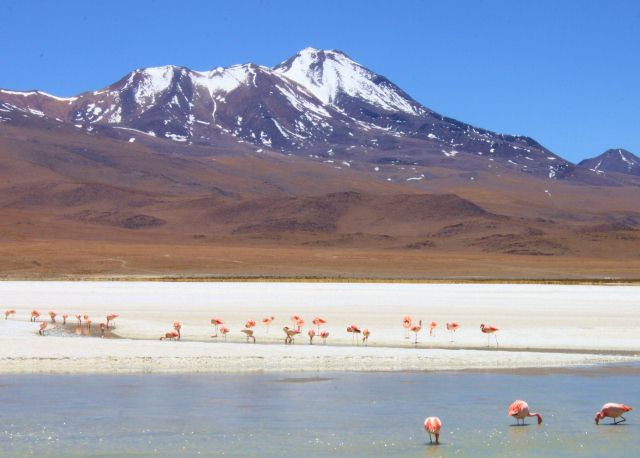
Flamingos!
     The second and third days of the trip found us driving through an unearthly landscape of giant volcanos, multicolored, flamingo filled lakes, bubbling mud pits and steaming geysers.Los Alerces national park truly feels like Mars. The abundance of volcanoes brings with it an abundance of minerals from lithium and borax to iron and uranium.  These minerals seep into the ground water producing lakes of every color of the rainbow.  Lago Colorado is bright red from a mixture of iron and borax while Lago Verde is, unsurprisingly, a vivid green color due to its high copper content.  Flamingos flock to these poisonous lakes to lay their eggs on the alkali island in the center simply because no other animals will go near them.

     In the early 1900's surrealist painter Salvador Dali must have thought he'd wandered into his own wet dream when he found the alien landscapes that make up this part of the world.  He came here for years to paint and to be inspired by the strange and desolate shapes carved by wind and time.  Indeed, many of the panoramas we saw on the trip found their way into some of his most famous paintings (The Perception of Memory, The Persistence of Time, Narciss ).  A particularly beautiful and strange part of the desert even bares his name.
Weird things happen in the Salvador Dali Desert

Tree rock

     After leaving Uyuni, Molly and I took a train to the small town of Tupiza about an hour and a half from the Argentine boarder. After a week and a half of traveling every day we needed some rest. For me, the train ride was almost like a trip back in time because this part of Bolivia lookes exactly like the American southwest. (Go St. John's!!!!!!!!)  It was here that Butch and Sundance finally met their makers and they must have felt right at home among the red rocks and cactus patches.
   
      Our time in Tupiza was lovely and slow. For more than a week before we arrived in Tupiza, every day involved some type of traveling, either by bus, train or 4x4, so we decided to kick back and chill a little.We got in touch with our inner cowboys by taking a horseback ride into the canyons around town. We hiked in the Tupiza hills and we even had our first international gig. While we were sitting in the central plaza playing guitar, a woman approached us and told us that there would be a street festival that Saturday. She asked how long we were staying in town and she invited us to play. Needless to say, we accepted. It was a huge success. The crowd was wonderful and very enthusiastic. They even sang along when we played Manu Chao. We played two quick sets and got called up for an encore!  It was a truly magical experience.